
Why are some people able to remain clear-headed and effective under pressure, while others become exhausted, freeze or withdraw? Why, when faced with the same demanding situation, do two equally competent employees react so differently?
An essential part of the answer lies in their coping strategies, also referred to as adaptation strategies. Long studied in psychology, they have become a major strategic consideration for HR professionals, coaches and managers because they directly influence sustainable performance, cooperation and quality of working life.
Coping strategies: what exactly are we talking about?
In psychology, coping strategies refer to the full range of cognitive, emotional, relational and behavioural responses that an individual draws upon to deal with a situation perceived as stressful, uncertain or beyond their available resources.
Two points are essential to avoid common misconceptions: coping strategies are not fixed personality traits, and no strategy is inherently “good” or “bad”. The same strategy may be functional in one context and become limiting when used rigidly, excessively or exclusively.
What makes the difference, therefore, is not the strategy itself, but the individual’s capacity for adaptive flexibility. It is precisely this flexibility that SCOPE aims to make visible, understandable and actionable in professional contexts.
How SCOPE approaches coping strategies
In SCOPE, coping strategies are viewed as preferred tendencies for adapting, each with potential strengths as well as points requiring attention. They are never interpreted in isolation, but rather in interaction with the other dimensions of the individual’s profile.
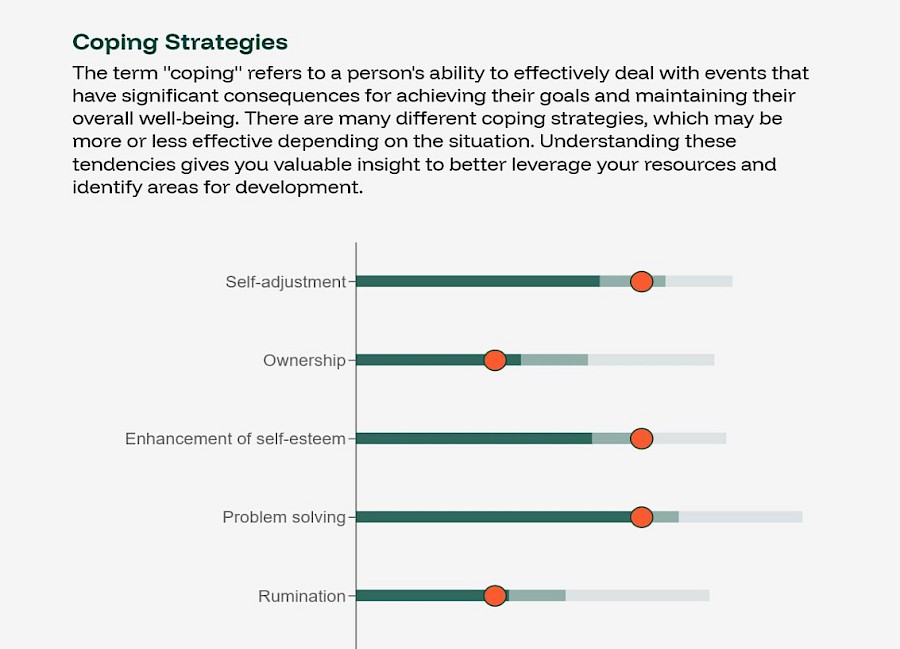
The nine coping strategies assessed
SCOPE distinguishes three families of coping strategies, according to how individuals mobilise their resources when faced with a stressful situation: self-focused strategies, centred on personal and identity-related adjustment; cognitive strategies, centred on the mental processing of the situation; and other-focused strategies, centred on relationships and the social environment.
These families are neither hierarchical nor mutually exclusive: effective adaptation often depends on combining them flexibly according to the context.
Self-focused coping
Self-modification refers to adjusting one’s beliefs, values or behaviours in order to adapt to a situation. It can be a source of growth, although it also carries a risk of excessive adaptation at the expense of one’s sense of identity.
Internal attribution refers to the tendency to explain events in terms of internal causes, such as one’s own efforts or abilities. It encourages personal responsibility, but can lead to excessive self-blame.
Self-enhancement consists of drawing on one’s strengths and past successes to preserve self-esteem. It can help a person recover from setbacks, provided they remain grounded in reality.
Cognitive coping
Problem solving refers to the tendency to analyse a situation, identify its causes and take concrete action. It is highly effective in complex environments, provided that the emotional dimension is not overlooked.
Rumination is characterised by repeatedly focusing on a problem and its consequences. It may signal that an issue is important, but when it persists it can impede action and amplify stress.
Magical thinking involves relying on irrational beliefs or rituals to reduce uncertainty. It may provide temporary reassurance, but can divert attention from taking responsibility and acting on the situation.
Other-focused coping
Seeking social support refers to the ability to ask others for help, advice or resources. It can be a powerful collective resource, provided it does not become a form of dependency.
Seeking empathy reflects a need for understanding, validation and emotional sharing. It can strengthen the sense of being supported, but may limit autonomy if relied upon exclusively.
Emotion suppression involves deliberately distancing oneself from one’s emotions. It can be useful in an emergency, but becomes costly over the longer term if it becomes a chronic pattern.
Why assess coping strategies in the workplace?
Imagine recruiting a team leader for a demanding working environment. Benoît, 41, is an external candidate with strong technical expertise and recognised management experience.
His SCOPE profile, which assesses among other things his strategies for adapting to stress, shows a strong tendency towards problem solving, a tendency to contain his emotions, and pronounced internal attribution. During the interview, Benoît comes across as structured, autonomous and committed—characteristics consistent with this way of adapting to professional demands.
However, the additional insight provided by SCOPE makes it possible to anticipate a potential risk of taking on too much responsibility and placing excessive pressure on himself: Benoît makes little use of social support and tends to rely primarily on his own resources when dealing with stressful situations. In a persistently demanding environment, this pattern could lead to an increased mental load for the candidate over the medium term.
Rather than excluding an otherwise competent candidate, SCOPE helps make the recruitment decision more robust: by clarifying the conditions required for success, adjusting expectations associated with the role and, where appropriate, putting targeted support in place. Coping strategies therefore become a key lever for recruiting not only on the basis of skills, but also on the capacity to adapt sustainably over time.
And you: how do you deal with pressure?
Take a moment to reflect. When faced with difficulty, do you tend to act, analyse, share or ruminate? Which strategies have helped you most throughout your career? Which ones now cost you more energy than they give you?
The key is not to change who you are, but to broaden your range of adaptive responses.
Conclusion: understanding in order to act more effectively
Understanding coping strategies provides a powerful lever for recruiting differently, supporting people more precisely and developing talent sustainably. For HR professionals, it supports more informed decision-making. For coaches, it provides a structured framework for building self-awareness. And for each individual, it offers an opportunity to understand themselves better and adapt more effectively—without losing themselves in the process.
SCOPE provides a structured and proven framework for transforming these strategies into a genuine lever for professional and human development, as well as sustainable performance.
Philip Chowney
https://ppe-evaluation.com/